

What is Return on Assets (ROA)?
Ever wonder if a company is actually any good at using its stuff to make money? That’s precisely what the Return on Assets (ROA) ratio tells you.
Think of it as a financial report card for a company’s efficiency. The return on assets definition is simple: it’s a measure of a company’s profitability in relation to all the assets it owns. Expressed as a percentage, ROA gives analysts, managers, and savvy investors like you a clear picture of how well a company is sweating its assets to generate profit.
In short, ROA answers the question: How much bang is the company getting for its buck?

How to Interpret Return on Assets
To get a real feel for what ROA means, you can’t just look at the number in a vacuum. Context is everything.
- Compare apples to apples: A tech company’s ROA will look wildly different from a car manufacturer’s because their asset needs are totally different. Always compare a company’s ROA to its direct competitors in the same industry.
- Track the trend: Is the company’s ROA getting better or worse over time? A rising ROA suggests improving asset efficiency, while a declining one might be a red flag.
The Return on Assets Formula Explained
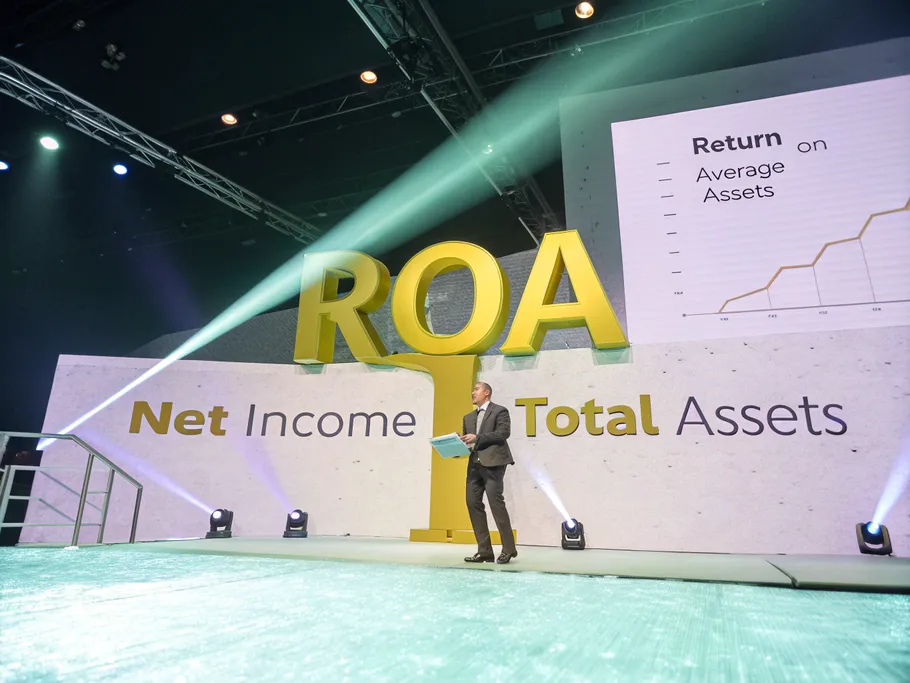
The basic return on assets formula is refreshingly simple. You just divide a company’s Net Income by its Total Assets. You can find the net income on the income statement and the total assets on the balance sheet.
The Basic Formula:
ROA = Net Income / Total Assets
Where:
- Net income: The profit left after you subtract all the costs of doing business, including expenses, interest, and taxes.
- Total assets: The sum of everything the company owns.
The More Accurate Return on Average Assets Formula
For a more precise calculation, you can use the return on average assets formula. This version smooths out potential distortions from big asset purchases or sales during the year.
ROA = Net Income / Average Total Assets
Using average assets gives you a truer picture of the company’s performance over the entire period. To get the final percentage, just multiply the result by 100.
What a Company’s ROA is Telling You
So, you’ve got the number. What does it actually mean? Let’s break down the good, the bad, and the ugly.
What is a High Return on Assets?
A high return on assets is the gold star. It means the company is a lean, mean, profit-generating machine, squeezing impressive earnings from relatively few assets. An ROA above 15% is often considered fantastic.
So, your ROA is off the charts?
Turns out, you don’t need more assets. You just need to make the ones you have actually work.
Companies with a consistently high ROA are masters of efficiency. They generate more profit with the same stuff as their competitors, setting them up for market leadership and long-term success.
What Does a Low ROA Mean?
A low ROA suggests a company is asset-heavy and struggling to turn those assets into profit. It’s like owning a fleet of delivery trucks but only using half of them. Management might not be getting the full potential out of what the company owns.
What About a Negative Return on Assets?
A negative return on assets happens when a company’s net income dips into the red. This isn’t always a catastrophe – the company could be investing heavily in new assets for future growth. But it could also just mean they’re losing money. Yikes.
What is a Good ROA?
Generally speaking, an ROA over 5% is considered pretty good, and anything over 20% is top-tier.
But the real answer to “what is a good ROA?” is: it depends on the industry. For capital-intensive industries like manufacturing, a 5% ROA might be great. For an asset-light software company, you’d want to see a much higher number. Always check the industry average before making a judgment.
How to Calculate Return on Assets: Step-by-Step
Let’s put the formula to work with a couple of real-world examples.
Exxon Mobil Corporation (XOM)
Here’s the data for Exxon from 2020 and 2021:
For 2020:
- Net income = $22,440 million
- Total assets = $332,750 million
For 2021:
- Net income = $23,040 million
- Total assets = $338,923 million
Solution:
- Exxon ROA for 2020:
- ROA = $22,440 million / $332,750 million
- ROA = 0.0674 = 6.74%
- Exxon ROA for 2021:
- ROA = $23,040 million / $338,923 million
- ROA = 0.0679 = 6.79%
Interpretation: Exxon’s ROA nudged up slightly, showing a small improvement in how it generated profit from its assets. Both figures are above the 5% “good” threshold.

Retail Company Comparison
Let’s calculate the ROA for three retail companies using their trailing 12-month data:
| Company A | Company B | Company C | |
|---|---|---|---|
| Net income | $1.7 billion | $996 million | $243 million |
| Total assets | $20.4 billion | $14.1 billion | $3.9 billion |
Calculations:
- Company A:
- ROA = $1.7 billion / $20.4 billion = 0.083 = 8.3%
- Company B:
- ROA = $996 million / $14.1 billion = 0.0706 = 7.06%
- Company C:
- ROA = $243 million / $3.9 billion = 0.0623 = 6.23%
Interpretation: Company A is the clear winner here, generating 8.3 cents of profit for every dollar of assets. All three, however, are showing a decent ROA for the retail sector.
How to Increase Return on Assets
If a company’s ROA is looking a bit sad, management has a few levers they can pull:
- Boost net income through better operations.
- Manage current assets more effectively.
- Squeeze more out of fixed assets to improve asset efficiency.
- Maximize returns from all investments.
- Get rid of unproductive assets to reduce the denominator while keeping profits steady.
Why Bother with the ROA Calculation?
ROA is a powerful tool for spotting opportunities. A rising ROA shows that management is getting better at its job, turning every dollar invested into more profit. A falling ROA, on the other hand, might mean the company has splurged on assets that aren’t pulling their weight.
It’s a direct measure of management’s performance, showing how well they use everything at their disposal – property, equipment, working capital – to make money for shareholders.
Limitations of the Return on Assets Formula
As useful as it is, ROA isn’t a silver bullet. It has some serious limitations.
For one, you absolutely cannot compare ROA across different industries. A retail company and an oil and gas giant have completely different asset bases, so comparing their ROA is meaningless.
Furthermore, accounting practices can distort ROA figures. Things like different depreciation methods can make a company’s performance look better or worse than it really is. The basic formula also gets a bit messy for non-financial companies because it compares profits for equity investors (net income) with assets funded by both debt and equity.
To get around this, analysts sometimes use a couple of variations:
- Variation 1: ROA = (Net Income + [Interest Expense × (1 – Tax Rate)]) / Total Assets
- Variation 2: ROA = (Operating Income × (1 – Tax Rate)) / Total Assets
Takeaways
- ROA stands for return on assets. It’s a percentage that shows how much net income a company generates from its total assets.
- A ROA over 5% is generally seen as good, but this varies hugely by industry. Always compare a company to its peers for a reliable assessment.
- A negative return on assets happens when a company has a negative net income (a loss) for the period.
- A high return on assets usually means the company is very efficient. However, an extremely high ROA could suggest the company isn’t investing enough in new assets for future growth.
- ROA increases when net income goes up or total assets go down.
- A supply management can boost net profit (the numerator) and reduce assets like inventory (the denominator), giving ROA a nice double-whammy boost.